Skip to content
OVistoaIntelligence index
AboutMethodologyPricingDocs
Sign inSign up
BREAKINGPerson found dead in car after it plows into health club in Portland, Oregon13 min ago
Top StoriesUnited StatesCanadaWorldPoliticsGeneralBusinessTechHealthAviationSportsArtificial IntelligencePublishers

Voting rights ruling amps up redistricting contests. Will states move before November?

7 articles · 7 outlets · spread 0.75

Voting rights ruling amps up redistricting contests. Will states move before November?
politics15 hr ago

Voting rights ruling amps up redistricting contests. Will states move before November?

Full coverage view across outlets, lean, source quality, and framing. Compare framing without algorithmic ranking.

7 articles7 outletsSpread 0.7512 claims
OVistoa

Article-level news analysis, transparent scoring, and API tools for readers, publishers, and teams that need source context.

DMCA and copyright review

Copyright owners can submit notices, counter-notices, and source material concerns through the dedicated review flow.

Open DMCA review

Product

  • Home
  • Feed
  • Search
  • Topics
  • Saved

Platform

  • About
  • Methodology
  • Home
  • Search
  • Saved
  • Me

From the Left

2 outlets
  • TIME·May 2

    How Voting Rights Groups Are Rallying to Fight After the Supreme Court Hollowed a Landmark Law

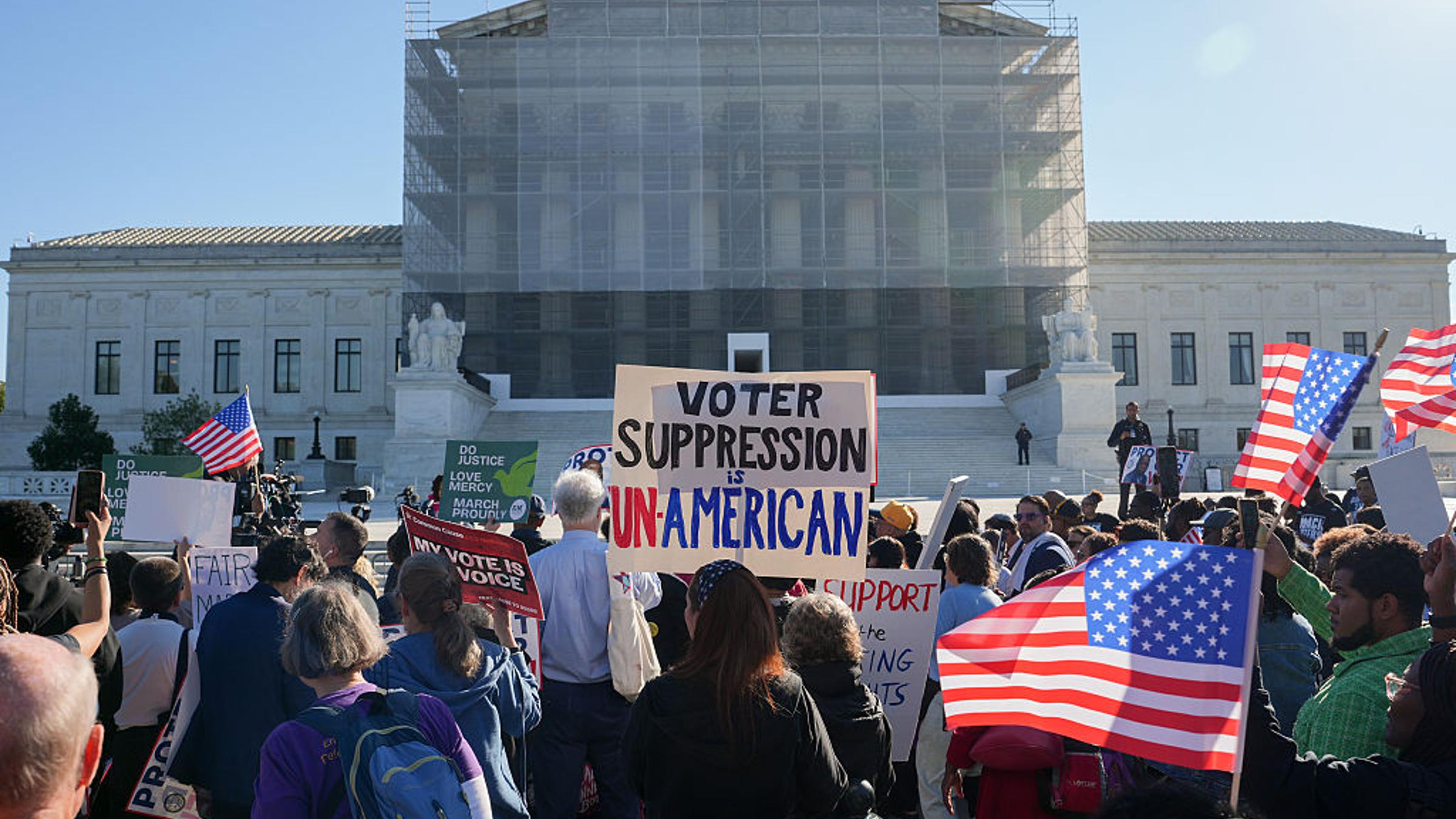
    In the wake of the Supreme Court ruling to narrow a core provision of the Voting Rights Act, voting and civil rights advocates in Southern states are rallying to attempt to protect the electoral power of racial minority groups. The conservative-majority court overturned Louisiana’s electoral map in a 6-3 ruling along ideological lines on Wednesday, finding that redrawing the state’s voting lines to add a second Black-majority district constituted an “unconstitutional racial gerrymander.”The decision significantly weakens Section 2 of the Voting Rights Act, which outlaws racial discrimination in voting and has been used for decades to protect against attempts to diminish minority voters’ electoral strength.The ruling could have sweeping consequences for minority representation in government and the balance of power in Congress. It opens the door for Republican-led states, particularly in the South, to redraw congressional maps to eliminate some majority-minority districts represented by Democrats in favor of new lines that could help the GOP gain additional seats in the House.“Under the Court’s new view of Section 2, a State can, without legal consequence, systematically dilute minority citizens’ voting power,” Justice Elena Kagan wrote in a dissenting opinion joined by her liberal colleagues that she opted to read out loud

  • Salon·May 1

    SCOTUS just unleashed a gerrymandering dragon

    analysis The Court's 6-3 decision gutting the Voting Rights Act will reshape the nation's political map in dramatic fashion Contributing Writer Published May 1, 2026 1:30PM (EDT) The Supreme Court's 6-3 decision in Louisiana v. Callais will do severe damage to voters (Douglas Rissing/Getty Images) So much for the mid-decade redistricting wars ending in a tie. On April 21, Democrats engineered themselves a 10-1 gerrymander in Virginia, a pickup of four seats. Party leaders declared it payback and boasted about their new fighting spirit. Political pundits declared the mid-decade gerrymandering war had been fought to a stalemate, or that it had even backfired on Republicans. Five new red seats in Texas, balanced by five blue ones in California. Four new Democratic seats in Virginia to counterbalance Ohio, Missouri and North Carolina. No harm, no foul! Then the big shoe dropped. The Supreme Court, in a 6-3, party-line decision in Callais v. Louisiana, struck down Louisiana’s congressional map and installed new limits on the Voting Rights Act that will make it all but impossible to challenge districts that dilute minority voters. A report by Fair Fight Action and Black Voters Matter found this could erase up to 19 House seats held

From the Center

5 outlets
  • The Washington Times·May 1

    Black voters could lose congressional seats after Supreme Court guts Voting Rights Act protection

    The Supreme Court’s gutting of a key Voting Rights Act protection is threatening to erase hard-won congressional representation for Black voters in Louisiana and Alabama — and Democrats are racing to court to stop it. The high court ruled Wednesday that Louisiana’s majority-Black district map violated the Voting Rights Act, reversing a lower court order that had guaranteed Black voters — and Democrats — a majority in two of the state’s six congressional districts. Under the previous map, Republicans held five of six seats. The ruling left Louisiana’s electoral future unsettled. Gov. Jeff Landry, a Republican, declared a state of emergency to halt voting — even though tens of thousands of absentee ballots had already been mailed and some had been cast and returned. Democrats immediately sued. “This court is asked to do something simple: stop a state from canceling an election that is already underway,” challengers said in a lawsuit filed Thursday. A lower court agreed, barring Louisiana from using the old 5-1 Republican map. In Alabama, state officials argued the ruling clears the way for a similar GOP-friendly redraw. The NAACP and the National Redistricting Foundation urged the Supreme Court not to fast-track those cases while voters are

From the Right

0 outlets

No coverage from this perspective yet.

Claim synthesis

Pro users see canonical claims across the cluster and which outlets reported each one.

Learn more

Outlets covering this story

TIMEThe Washington TimesABC NewsSalonNewsweekAl JazeeraChristian Science Monitor

First seen

Apr 30, 2026

Latest

May 2, 2026

Outlets

7

Diversity

100/100

  • Pricing
  • API docs
  • Publishers
  • Account

    • Sign in
    • Create account
    • Reader settings
    • API console

    Legal

    • Terms
    • Privacy
    • Security
    • DMCA

    © 2026 Vistoa. All rights reserved.

    Limited excerpts, attribution, analysis, and outbound publisher links remain core product boundaries.

    ABC News·May 1

    Which states might redraw congressional maps in 2026, 2028 after Supreme Court's Voting Rights Act ruling

    The bare-knuckle, partisan mid-decade redistricting battles that have occurred across the country over the past year and a half might become the new normal in the light of a landmark Supreme Court ruling on Wednesday that could impact congressional maps and minority representation nationwide. The ruling in Louisiana v. Callais could result in states redistricting every few years, instead of every 10 after the release of census data. But with many states' candidate filing deadlines having passed, it's not clear how many more congressional seats could be redrawn because of this ruling ahead of November's midterm elections -- although there could be Republican-controlled states that use the ruling to redistrict ahead of the 2028 elections, and Democratic-controlled ones that plan to respond.Joshua Stockley, a political science professor at the University of Louisiana Monroe, said the country is already seeing "a domino effect" of redistricting, which the ruling could supercharge. People walk outside the U.S. Supreme Court building in Washington, March 14, 2026.Will Dunham/Reuters"I think Republicans and Democrats, both parties, are going to continue to try to create as many non-competitive or favored districts as they can until we get to a point where somebody steps in and says, 'Enough is

  • Newsweek·May 1

    Supreme Court Faces New Decision in Major Voting Rights Case

    The Supreme Court is facing a new decision on how to proceed in a Louisiana redistricting case just days after the justices released an opinion that critics said weakened the Voting Rights Act. The court announced its decision in Louisiana v. Callais on Wednesday, ruling that a map drawn by the state was an unconstitutional racial gerrymander and that the Voting Rights Act did not require Louisiana to create an additional majority-minority district. Attorneys for Phillip Callais and other respondents in the initial Supreme Court case submitted an application on Wednesday asking the court to immediately issue its judgment and send a certified copy to a Louisiana district court. Under court rules, the clerk does not send a copy of a judgment to a district court for at least 32 days from the decision’s release, unless the court decides to expedite the process. Attorneys for several plaintiffs in the initial case, excluding Louisiana, filed a response on Thursday opposing the application and requesting that the court grant them the opportunity to seek a rehearing. Louisiana took no position on the application. “I think these requests are unusual, but this is not a usual case,” Neama Rahmani, a former federal prosecutor

  • Al Jazeera·Apr 30

    Has the US Supreme Court weakened the Voting Rights Act – and how?

    The United States Supreme Court has voided a key provision of a landmark civil rights law by ruling that the electoral map of Louisiana had been drawn up unconstitutionally to create two Black-majority districts.The decision represents a major reinterpretation of the landmark Voting Rights Act of 1965 – in particular, its provision designed to protect minority voters from having their political power diluted.It is unclear how much of that provision – Section 2 of the act – remains in force.Wednesday’s Supreme Court ruling is seen as a major win for Louisiana Republicans and President Donald Trump’s administration and is expected to make it harder for minorities to challenge electoral maps as racially discriminatory under the 1965 law.Louisiana Governor Jeff Landry told Republican candidates for the House of Representatives on Wednesday that he planned to suspend next month’s primary elections to allow state lawmakers time to approve a new congressional map, The Washington Post reported, quoting two people with knowledge of the calls.The latest ruling comes during a wider battle over congressional redistricting before midterm elections in November.What has the Supreme Court ruled?The court held that a map that created two Black-majority congressional districts in Louisiana was unconstitutional. The 6-3 ruling

  • Christian Science Monitor·Apr 30

    Voting rights ruling amps up redistricting contests. Will states move before November?

    The Supreme Court’s 6-3 decision on Wednesday to sharply curtail the use of race in drawing electoral districts under the Voting Rights Act could carry big repercussions for political representation among minority communities, and appears certain to further ramp up partisan redistricting debates. But the timetable might be too tight for most states to redraw their maps before November’s elections.The ruling in Louisiana v. Callais struck down as unconstitutional a Black-majority congressional district in Louisiana. The decision was quickly seized upon by some Republicans as an opening to eliminate other safe Democratic seats in GOP-controlled states that had previously been protected under the landmark 1965 civil rights law. At least a dozen such House seats, many in the South, are seen as vulnerable, creating an opportunity for significant Republican gains. And it also appears likely to reduce the number of Black and Hispanic lawmakers in Congress, because the GOP conference is overwhelmingly white. Conservative legal scholars have long argued that drawing district lines to protect the voting power of racial minorities was a violation of constitutional safeguards against racial discrimination. On Wednesday, the court’s conservative majority agreed. While it did not wholly strike down Section 2 of the Voting Rights