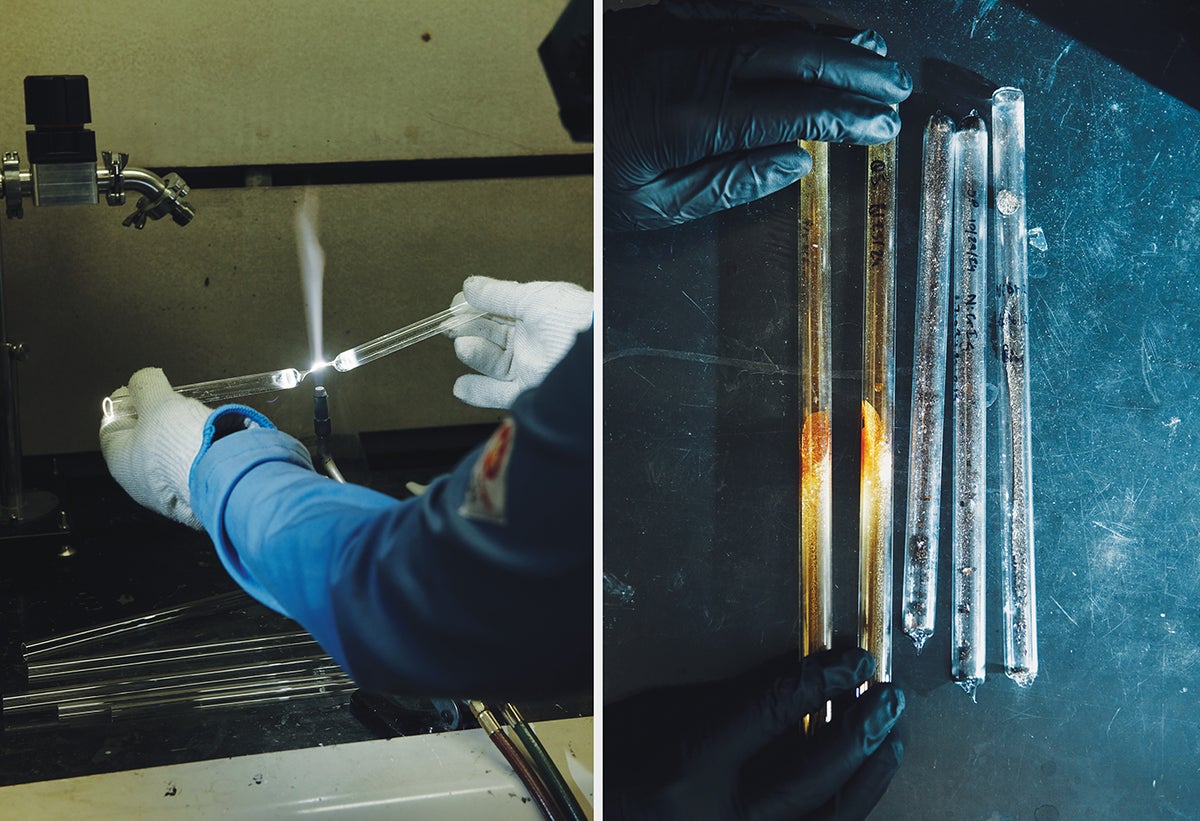
On a breezy afternoon last autumn in Cambridge, Mass., in a laboratory thrumming with the huff-whish-huff sound of refrigeration pumps, Massachusetts Institute of Technology graduate student Jiaruo Li was crafting a new device for storing digital data. She was aiming to use an exotic kind of magnetism discovered in the same lab the previous year to make the device faster and more energy-efficient than any competing technology. Her goal was timely given the current AI-driven boom in data centers and the exploding demand for power it portends.At that moment Li was focused on finding her version of a needle in a haystack: a barely visible flake of nickel bromide with just the right attributes. To get to this point, she’d grown a dime-sized crystal of the compound by baking a glass tube containing nickel bromide powder for 10 days at high temperatures in a computer-controlled oven in an M.I.T. lab. Then, seeking an atomically thin sample, she’d applied a special tape to her creation, peeled it off and transferred the flakes on the tape to a shiny silicon wafer. Now, holding the wafer up to the light, she eyed a galaxy of thousands of tiny golden crystals against a purple
Lean: n/a · Source quality n/a · Factual vs opinion n/a.
© 2026 Vistoa. All rights reserved.
Limited excerpts, attribution, analysis, and outbound publisher links remain core product boundaries.