Skip to content
OVistoaIntelligence index
AboutMethodologyPricingDocs
Sign inSign up
BREAKINGPerson found dead in car after it plows into health club in Portland, Oregon2 hr ago
Top StoriesUnited StatesCanadaWorldPoliticsGeneralBusinessTechHealthSportsAviationArtificial IntelligencePublishers

Scientists use AI to test whether life can run on only 19 amino acids

1 articles · 1 outlets · spread 0.00

Scientists use AI to test whether life can run on only 19 amino acids
synthetic biology2 d ago

Scientists use AI to test whether life can run on only 19 amino acids

Full coverage view across outlets, lean, source quality, and framing. Compare framing without algorithmic ranking.

1 articles1 outletsSpread 0.0012 claims
OVistoa

Article-level news analysis, transparent scoring, and API tools for readers, publishers, and teams that need source context.

DMCA and copyright review

Copyright owners can submit notices, counter-notices, and source material concerns through the dedicated review flow.

Open DMCA review

Product

  • Home
  • Feed
  • Search
  • Topics
  • Saved

Platform

  • About
  • Methodology
  • Home
  • Search
  • Saved
  • Me

From the Left

0 outlets

No coverage from this perspective yet.

From the Center

1 outlet
  • Scientific American·Apr 30

    Scientists use AI to test whether life can run on only 19 amino acids

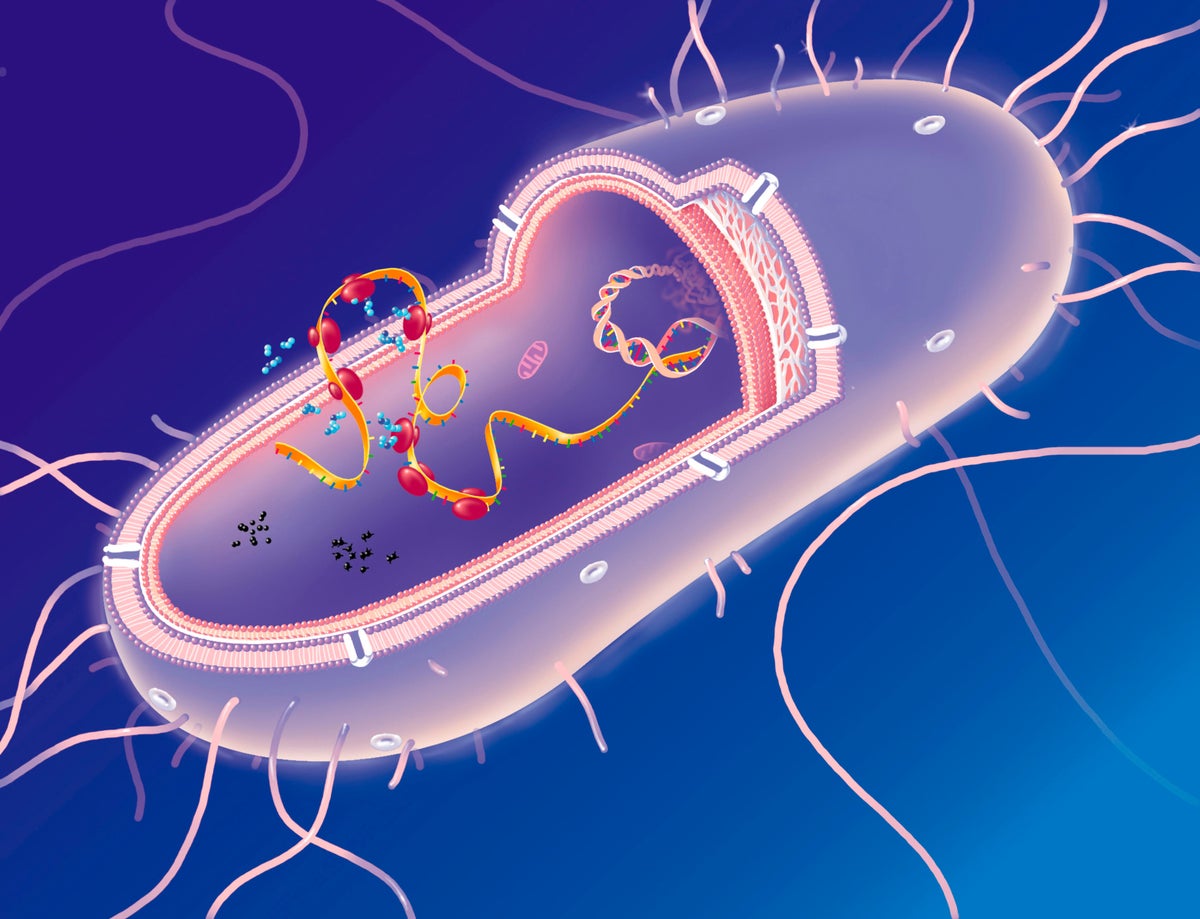
    April 30, 20264 min read Add Us On GoogleAdd SciAmScientists used AI to rewrite part of life’s alphabetAn engineered E. coli strain survived after one amino acid was designed out of many of its ribosomal proteins—an early test of whether life’s chemistry can be simplifiedBy Jacek Krywko edited by Eric SullivanAn illustration of protein production inside a bacterium. In a new study, researchers used AI to redesign some E. coli ribosomal proteins to work without the amino acid isoleucine. BSIP/Education Images/Universal Images Group via Getty ImagesNearly all known life builds proteins from the same alphabet of 20 canonical amino acids. Strung together in different orders, those building blocks form the proteins that make cells work. In a new Science study, researchers at Columbia University, the Massachusetts Institute of Technology and Harvard University used artificial-intelligence-guided protein design to test how much of that alphabet can be pared back: they engineered an Escherichia coli strain that survived after it was redesigned to not have a specific amino acid in its ribosomal proteins.The team did not create a true 19-amino-acid organism. The engineered strain still uses the targeted amino acid, isoleucine, throughout most of its genome. But the result suggests that one of

From the Right

0 outlets

No coverage from this perspective yet.

Claim synthesis

Pro users see canonical claims across the cluster and which outlets reported each one.

Learn more

Outlets covering this story

Scientific American

First seen

Apr 30, 2026

Latest

Apr 30, 2026

Outlets

1

Diversity

100/100

  • Pricing
  • API docs
  • Publishers
  • Account

    • Sign in
    • Create account
    • Reader settings
    • API console

    Legal

    • Terms
    • Privacy
    • Security
    • DMCA

    © 2026 Vistoa. All rights reserved.

    Limited excerpts, attribution, analysis, and outbound publisher links remain core product boundaries.