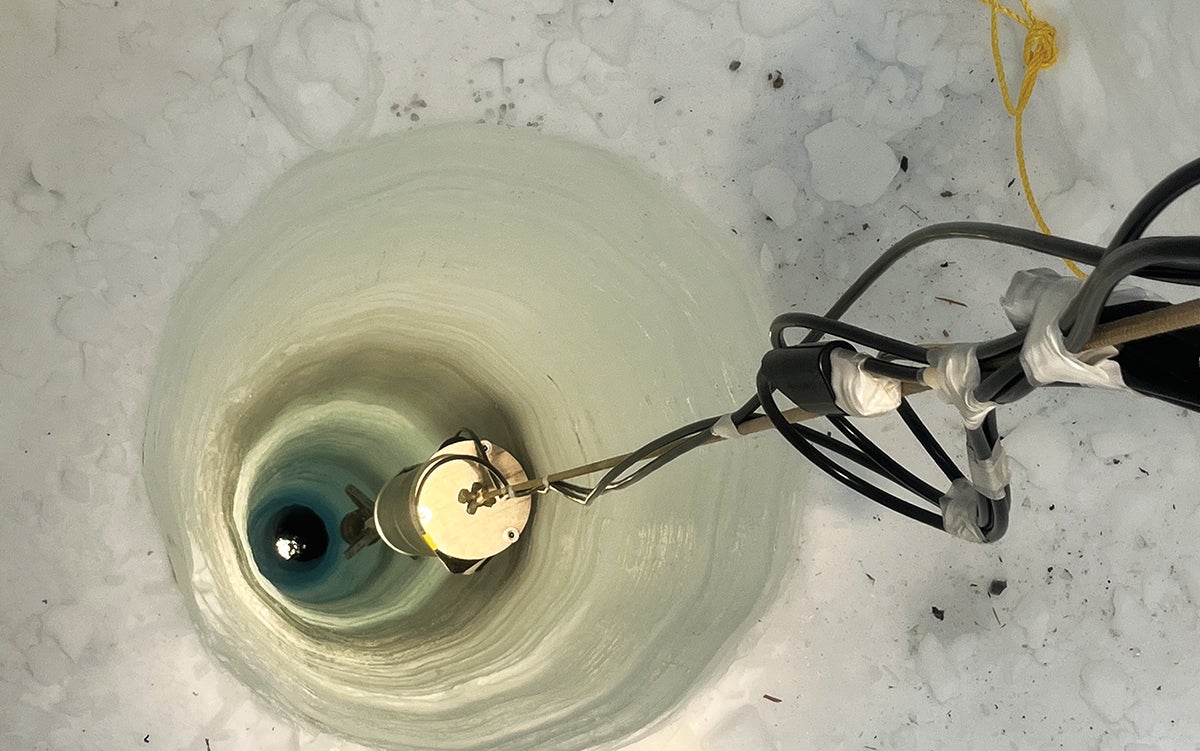
Here’s how scientists drilled 8,000 feet through ice to place the world’s deepest seismometersBy Vanessa Bates Ramirez edited by Sarah Lewin FrasierResearchers drilled 8,000 feet into South Pole ice to install two seismometers. Robert Anthony/USGSJoin Our Community of Science Lovers!On the surface, Antarctica’s vast ice sheet appears still and unchanging. But deep below, vibrations ripple through the frozen plain, transmitting the movements of Earth’s tectonic plates—and scientists now have a formidable new set of tools to listen in with. The U.S. Geological Survey (USGS), collaborating with the IceCube Neutrino Observatory at the South Pole, has installed the deepest seismometers ever deployed. At 8,000 feet under the ice, the two instruments will record earthquakes of magnitude 5 or greater anywhere on the planet with unprecedented accuracy and help to reveal new details of Earth’s deep interior in the process.The South Pole is one of Earth’s quietest places because there is very little humanmade infrastructure and no background “noise” from the planet’s rotation, which can distort seismometer data. At their depth, the new seismometers may also be shielded from disruptive changes in atmospheric pressure, says USGS research geophysicist Robert Anthony, the Deep Ice Seismometer project manager.Engineers “drilled” holes by shooting pressurized hot
Lean: n/a · Source quality n/a · Factual vs opinion n/a.
© 2026 Vistoa. All rights reserved.
Limited excerpts, attribution, analysis, and outbound publisher links remain core product boundaries.