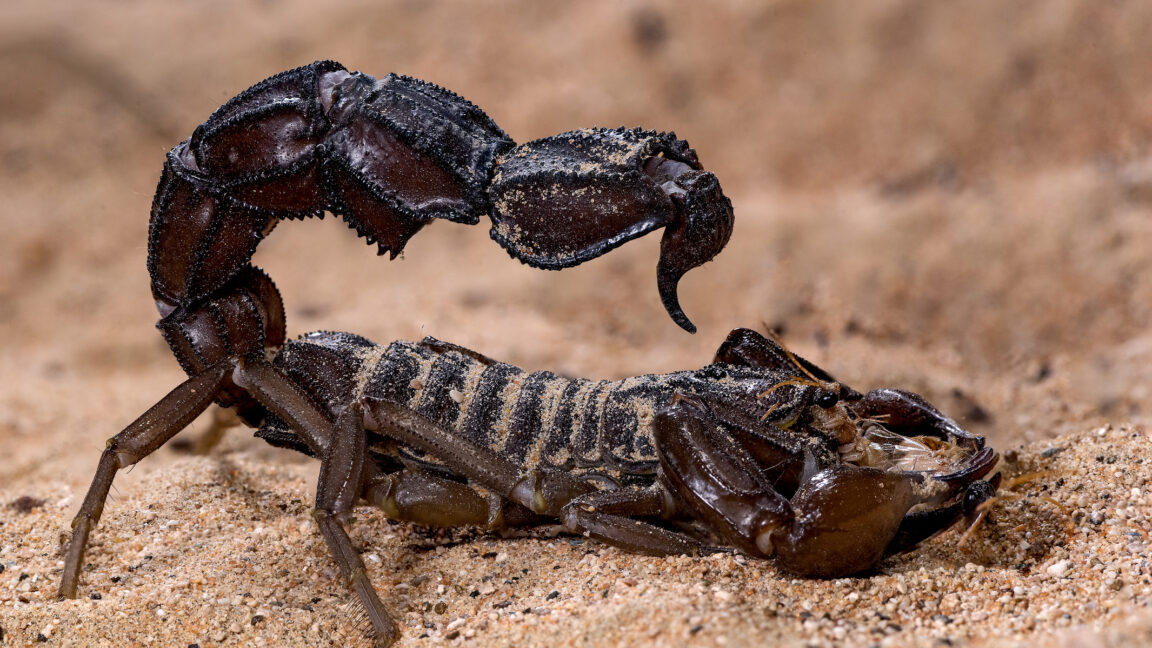
It is actually very metal Different hunting patterns seem to dictate different distributions of metal. Scorpions are armed with dual front pincers (technically known as chelae or pedipalp appendages) and a venom-injecting telson, or stinger, on the posterior of their tail. These things look dangerous enough on their own, but a chemical examination showed they contain metals like zinc, manganese, and iron. “That the metals are there has been known since the 1990s,” said Sam Campbell, a biologist at the University of Queensland, Australia. “What we didn’t know was whether scorpions evolved to be like that or if it was accidental and they were just picking the metals up from the environment.” To answer this question, Campbell and his colleagues examined how metals are distributed across the stingers and pincers of different scorpion species. Based on their data, detailed in a recent study published in the Journal of The Royal Society Interface, there was nothing accidental about it. Mapping the weapons Campbell’s team focused on 18 scorpion taxa selected from a large collection at the Smithsonian National Museum of Natural History. To map the molecular structure of the scorpions’ weaponry, the researchers used high-resolution scanning electron microscopy coupled with micro-X-ray
Lean: n/a · Source quality n/a · Factual vs opinion n/a.
© 2026 Vistoa. All rights reserved.
Limited excerpts, attribution, analysis, and outbound publisher links remain core product boundaries.