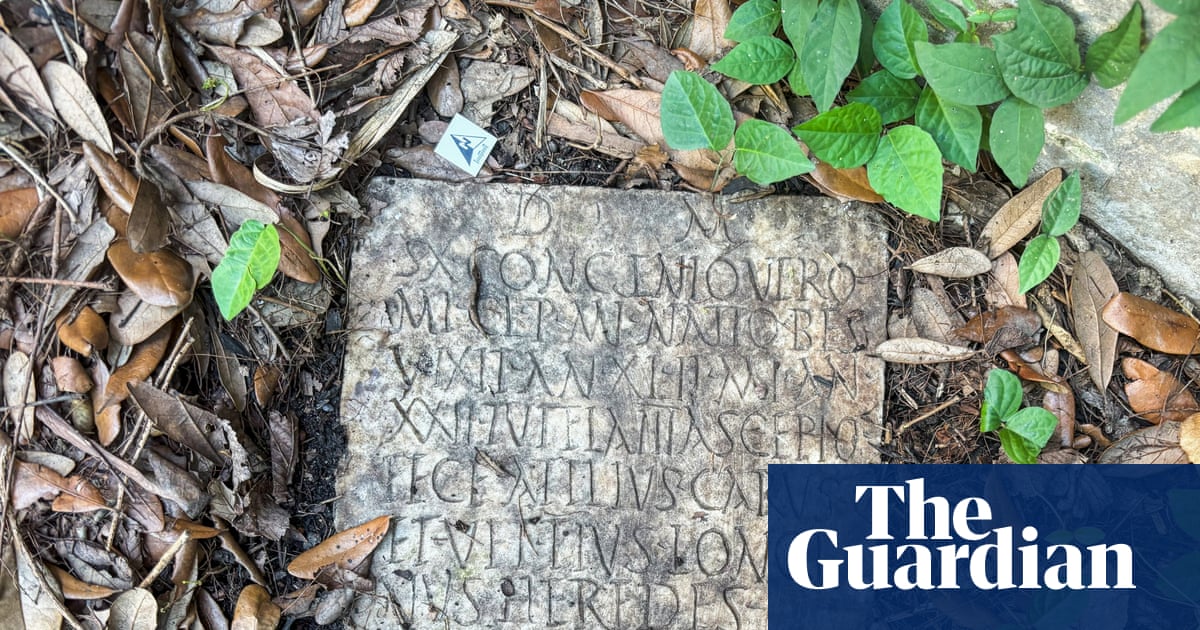
A nearly 2,000-year-old Roman grave marker discovered in a New Orleans backyard has now been returned to Italy.The marble epitaph – dating back roughly 1,900 years – was officially handed over to Italian officials in Rome on Wednesday during a ceremony led by the FBI. The event also marked the repatriation of another antiquity recovered in the US, the agency said.The artifact first came to light last year when Tulane University anthropologist Danielle Santoro and her husband, Aaron Lorenz, were clearing undergrowth in their yard. The couple noticed a slab with an unusually smooth surface and a carved inscription that appeared to be in Latin.Santoro reached out to experts, including the University of New Orleans archaeologist Ryan Gray, over concerns that their historic home might sit atop an unmarked burial site.Further analysis, assisted by Tulane University’s classical studies professor Susann Lusnia and other specialists, revealed the stone to be a grave marker dedicated to Sextus Congenius Verus, a Roman sailor and military figure believed to have lived in the second century. The artifact also matched records of a piece reported missing from the city museum in Civitavecchia, near Rome.The Roman grave marker, in the background, at a repatriation ceremony in
Lean: n/a · Source quality n/a · Factual vs opinion n/a.
© 2026 Vistoa. All rights reserved.
Limited excerpts, attribution, analysis, and outbound publisher links remain core product boundaries.